2026-09-14
Causes of Breast Implant Rippling: Is Revision Surgery Really Necessary? <Plastic Surgeon Q&A>
Discover why breast implant rippling occurs, why slender individuals are more prone to it, and why revision surgery is not always necessary to correct it.

After breast augmentation,
while enjoying satisfying results,
some patients are startled
to notice a rippling or wavy texture
on the surface of their breasts
while taking a shower or looking in the mirror.

Searching for symptoms online often brings up
alarming claims like,
"It's a serious side effect,"
or "The implant must be removed immediately."
Naturally, anxiety begins to skyrocket.
This phenomenon, where the breast surface looks or feels wavy like water ripples,
is called 'rippling.'



To get straight to the point
and give you the conclusion first:
Experiencing rippling does not mean
something is automatically wrong
or that you urgently need revision surgery.
Depending on the circumstances under which the symptoms appear,
it could be a completely natural phenomenon,
or it might be a condition
that requires correction.
Today, we will explain step by step
why rippling actually occurs
and how you should address it.
1. Why does rippling happen in the first place?
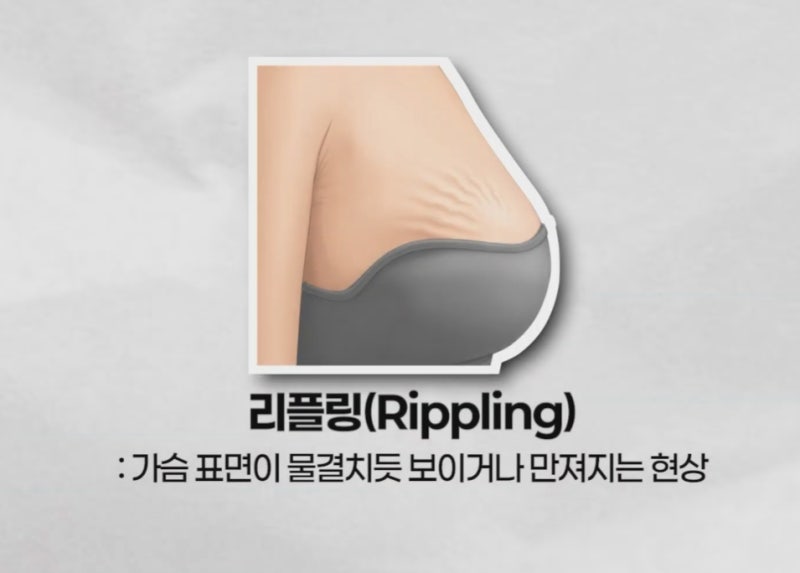
To understand rippling, you must first
understand this fundamental fact:
Wrinkling inside a breast implant
is inherently normal.
Thinking of a water balloon
makes this easy to grasp.
If you don't fill a balloon completely with water and leave it slightly slack,
the surface folds in various spots,
creating creases and wrinkles, right?
Breast implants are similar.
If an implant is too rigid,
it cannot mimic natural movement,
so it is purposefully designed to be flexible.
Due to this flexibility,
internal folds and creases
are structurally inevitable.
In other words, the way breasts move naturally
when lying down or moving around
is thanks to this very flexibility.

The real issue is:
"Can these internal folds be seen from the outside?"
In breast augmentation,
layers of skin, subcutaneous fat, and muscle
cover the implant from above.
If this tissue 'cover'
is adequately thick,
the internal folding remains completely invisible
from the outside.
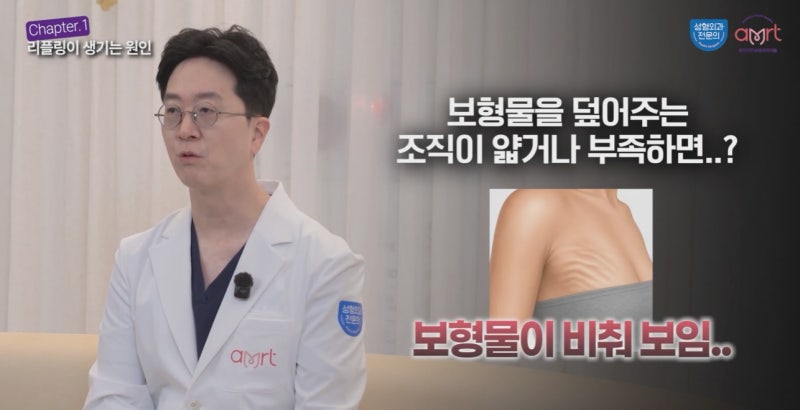
However, when this cover thins out,
the internal wrinkles begin to show through
or become palpable on the surface.
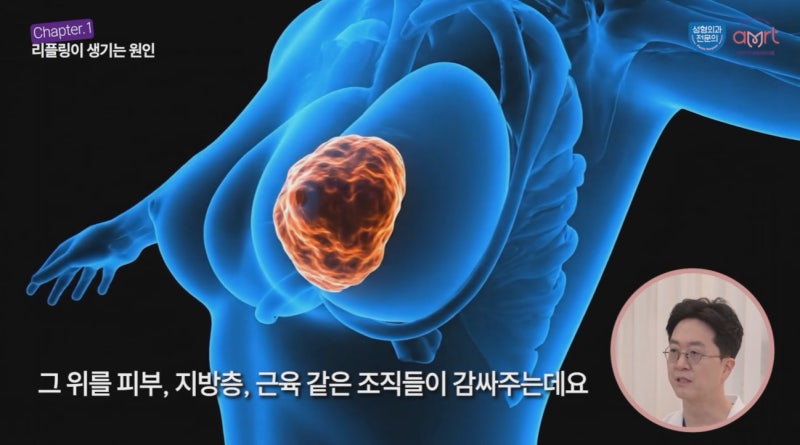
So, what causes this 'cover'
to become thin?
There are three main scenarios:
1) Naturally thin native tissue
For those with naturally thin skin
or minimal baseline fat tissue,
the tissue simply lacks the inherent thickness
needed to conceal the implant.
Even with the exact same implant,
rippling becomes much more prominent.
2) Choosing an implant size that exceeds tissue capacity
Just as stuffing an oversized pillow onto a small bed
stretches the cover taut and thin,
placing an implant too large for one's frame
overstretches the overlying skin and tissue,
increasing the chances of internal folds showing through.
3) Implant placement plane
When an implant is placed above the muscle (subglandular),
it directly abuts the skin and fat,
making ripples much more visible.
Conversely, placing it beneath the muscle (submuscular)
adds a thick blanket of muscle coverage,
dramatically reducing the occurrence of rippling.
However, areas along the lower or outer borders
where the pectoral muscle naturally doesn't reach
cannot be entirely covered by muscle.
2. Why is rippling particularly common in slender body types?

Rippling concerns tend to be
relatively more common in petite,
lean individuals.
The reason directly correlates
with what was explained above:
They inherently lack an adequate layer
of subcutaneous fat and soft tissue
to envelope the implant.
Therefore, for slender individuals,
chasing "solely the softest possible feel"
can be risky.
Here lies a dilemma rooted in
implant characteristics:
1) Fill rate
2) Gel cohesiveness
Implants with a lower fill rate (such as older smooth implants filled to around 80%),
or products with softer, more fluid gel,
feel remarkably soft to the touch,
but their empty volume means they wrinkle more easily.
In contrast, implants with high fill ratios
and high gel cohesiveness
retain their shape well and resist wrinkling,
though they may feel slightly firmer
or bouncier to the touch.
Thus, for lean patients
with a higher risk of rippling showing through,
it is critical not to evaluate only how soft the implant feels,
but to comprehensively weigh cohesiveness and fill rate.
Choosing an implant that folds less
is key to prevention.

※ Caution : Never let your guard down during postoperative care. Undergoing rapid weight loss through trendy diet injections or extreme dieting causes the fat layer covering the implant to diminish as well, potentially causing previously hidden rippling to suddenly show on the surface. This is the clear reason why rapid weight loss should be avoided after breast augmentation. |
3. Does rippling always require revision surgery?
This is likely the greatest source of concern.
As noted earlier,
if rippling appears only temporarily
when making wide arm motions or bending forward,
you can rest assured.
This is actually evidence that the implant
is behaving normally and naturally.
However, if noticeable rippling persists even while standing still,
or if the wrinkles worsen over time
and are accompanied by pain or shape distortion,
a professional evaluation is necessary.
Even so, a consultation does not automatically mean
revision surgery is the only path forward.
Depending on the root cause,
much less invasive solutions are available.

First, if rapid weight loss was the trigger,
simply regaining a modest amount of weight
can restore the depleted fat layer
and improve the condition.
Alternatively, autologous fat grafting
can be performed specifically over the thin areas where creases show.
By deliberately bolstering the thinned tissue cover,
the underlying implant folds are effectively concealed.
Of course, in severe cases involving advanced capsular contracture
or actual implant damage,
implant replacement or revision surgery may be required.
The key takeaway is to avoid imagining the worst-case scenario in front of the mirror
and instead visit a specialist clinic
to accurately identify the cause.
In summary, rippling is not inherently
an implant defect
or a surgical failure.
It is simply a natural physical characteristic
engineered into implants to maintain a soft, lifelike feel.
However, to prevent this from becoming visible or bothersome,
an objective anatomical analysis of the individual's frame
and meticulous planning to select the ideal implant type and placement
are absolutely essential.
<Helpful Related Column>
Amorata Plastic Surgery |
Main Tel: 02-522-0955 3F, Square Cube, 28 Seocho-daero 78-gil, Seocho-gu, Seoul |
This post was authored directly by Amorata Plastic Surgery
in compliance with Article 56 of the Medical Service Act
to provide accurate medical information.
Every procedure/surgery carries risks of minor or major side effects depending on the individual;
please make informed decisions after thorough consultation with medical specialists.
Frequently Asked Questions
Does breast implant rippling always require revision surgery?
No, revision surgery is not always required. Rippling that appears only temporarily when bending forward is a natural phenomenon. In many cases, non-surgical approaches such as restoring lost weight or autologous fat grafting can effectively resolve the issue.
Why is rippling more common in slender or lean individuals?
Lean individuals naturally have thinner skin and subcutaneous fat layers covering the implant. When this soft tissue cover is thin, the natural folds and creases that form inside the flexible implant are much more likely to show or be felt on the surface.
Can dieting after breast augmentation cause rippling?
Yes, rapid weight loss can induce rippling. Losing weight reduces the subcutaneous fat layer that covers the implant, thinning the protective tissue cover and allowing underlying implant wrinkles to become visible on the surface.
When should I see a plastic surgeon for breast rippling?
You should seek a professional consultation if significant rippling is noticeable even while standing straight, if it worsens over time, or if it is accompanied by breast deformity or pain. These signs warrant an in-depth clinical evaluation.