2026-10-02
Can You Safely Breastfeed After Breast Augmentation? <Answered by a Board-Certified Surgeon with 20 Years of Experience>
Worried about breastfeeding after breast augmentation? Learn why surgical anatomy, muscle layers, and capsule formation keep breast milk completely safe and unaffected.


Hello.
I am Dr. Seung-Beom Han, Head Plastic Surgeon at Amorata Plastic Surgery.
For the past 20 years, I have focused solely on breast augmentation surgery.
During consultations, I often meet patients who have suffered long-term distress from deep-seated insecurities, yet remain hesitant to go through with surgery.
Among their concerns, the single biggest and most realistic worry is often:
'Will I still be able to breastfeed after childbirth?'
"If the implant fills my breast, won't it block the milk ducts?"
"What if harmful substances like silicone leak out and get into my breast milk?"
For any prospective mother planning for a future child, having these concerns is entirely natural.
In fact, seeing patients walk away from surgery due to vague fears and misconceptions is always heartbreaking for me as a physician.

Let me begin by giving you a clear conclusion.
Even after breast augmentation surgery, there is no problem whatsoever with breastfeeding.
This is not merely empty reassurance to make you feel better.
Allow me to explain from an anatomical perspective why breastfeeding is completely viable following breast augmentation surgery.
1. The 'factory' producing breast milk and the 'room' housing the implant are completely separate.

To understand why breastfeeding remains safe after surgery, you first need to understand where breast milk is produced and how it flows.
Breast milk is not produced everywhere throughout the entire breast.
Inside the breast, there is the 'glandular tissue' (mammary gland), which acts as the production factory, and the 'milk ducts', which serve as the pathways for milk delivery.
During breast augmentation, the implant we insert completely bypasses this 'milk factory' (glandular tissue) and is positioned in a much deeper anatomical layer.
Imagine our body as a multi-story building.
If the glandular tissue where milk is produced is on the '1st floor', the space where the implant sits is down on the 'basement level', beneath a sturdy barrier made of the pectoralis major muscle and deep fascia.
During surgery, the implant is always placed underneath the mammary gland tissue.
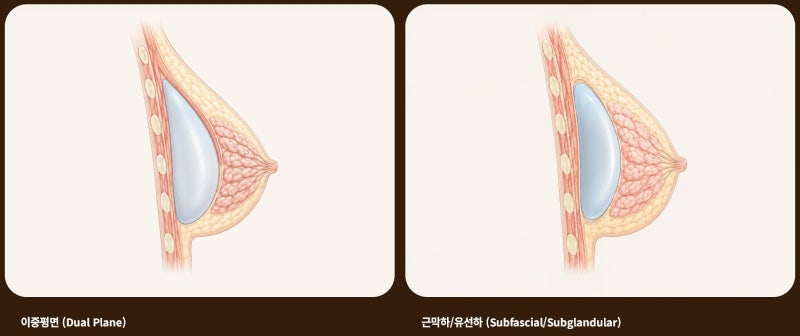
When performed using the 'dual-plane (submuscular)' approach, a thick muscle wall separates the glandular tissue from the implant.
Even with a 'subfascial' placement, the fascia—one of the toughest structural tissues in the human body—isolates the implant from the mammary glands.
On top of this, our body naturally develops a powerful protective barrier called the 'capsule'.
Once an implant is placed in the body, the body naturally forms its own fibrous capsule tissue surrounding it, sealing the implant into a completely isolated pocket.
In other words, for the worst-case scenario that patients fear—'silicone mixing into breast milk'—to occur, three miraculous conditions would have to happen at the exact same time:
1) The tough outer shell of the implant must completely rupture,
2) The dense capsule sealing the implant must tear open, and
3) The leaked filler material must somehow penetrate thick muscle and fascia to travel upwards into the mammary gland tissue.
Anatomically, such an occurrence is practically impossible.
Because these are two completely sealed, independent compartments, the implant essentially has no impact on milk production or delivery.
2. What truly matters is establishing a 'personalized, safe surgical plan'.

Even when medical safety is repeatedly confirmed, it is understandable to still feel anxious since this is an operation on your own body.
That is why, once you decide to proceed with surgery, there is one crucial principle to keep in mind.
You should never fixate on a 'specific surgical method' based on internet rumors or friends' personal reviews.
Online communities are full of claims such as:
"You must get an axillary (armpit) incision if you want to breastfeed."
"Using brand XX implants causes less damage to the mammary glands."
However, when it comes to breast augmentation, there is no single 'cure-all technique' that is universally ideal for breastfeeding.
This is because every person has different rib cage dimensions, skin thickness, volume of glandular tissue, and muscle development.

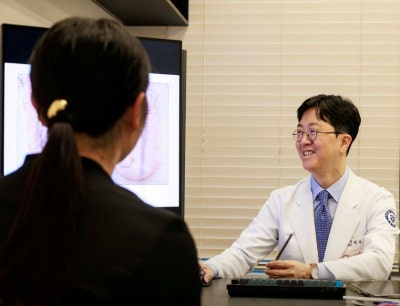
The key is discovering a 'customized surgical approach' tailored specifically to your body.
Whenever I consult patients planning for future pregnancy, this consideration takes absolute priority.
Anticipating the future expansion and contraction of breast tissue, we select an incision site designed to minimize mammary gland disruption to virtually zero percent.
We also carefully map out the ideal placement plane for the implant.
Rather than following what worked for someone else, undergoing thorough ultrasound evaluation and in-depth consultation to determine 'the safest surgical approach for your body type and future goals' is the genuine cornerstone of successful surgery.

If you genuinely desire breast augmentation but are holding back out of worry about future pregnancy and nursing, do not struggle alone.
We encourage you to visit an experienced specialist for a professional, personalized evaluation.
<Related Article to Read>
Amorata Plastic Surgery |
Phone: 02-522-0955 3F Square Cube, 28 Seocho-daero 78-gil, Seocho-gu, Seoul |
This article was directly authored by Amorata Plastic Surgery in compliance with Article 56 of the Medical Service Act, intended solely for providing accurate medical information.
All surgical procedures carry potential risks and side effects that may vary among individuals. Please consult thoroughly with a medical specialist before making any decision.
Frequently Asked Questions
Can I still breastfeed after breast augmentation surgery?
Yes, you can breastfeed without any issue. The milk-producing glandular tissue and the pocket where the implant is inserted are completely separated by layers of muscle and fascia, so the function of the mammary glands is not affected.
Is there any risk of silicone leaking into breast milk?
No, the risk of silicone mixing into breast milk is virtually nonexistent. Inside the body, the implant is securely sealed within a dense capsule, and thick muscle and fascia separate it from the milk glands, preventing any material from migrating into the breast tissue.
Can an implant block the milk ducts?
No, it is highly unlikely to block the milk ducts. During breast augmentation, implants are placed beneath the pectoralis muscle (dual-plane) or subfascial layer, far below the glandular tissue and milk ducts, leaving milk pathways unobstructed.
Do I have to choose a specific incision technique to breastfeed safely?
No, there is no single mandatory incision technique for breastfeeding. Because chest structure, glandular volume, and tissue thickness vary per individual, the safest incision and placement method should be determined through ultrasound examination and personalized consultation.