2026-10-01
Breast Augmentation: How to Avoid Capsular Contracture and Rippling?
Expert insights on preventing breast augmentation side effects like capsular contracture and rippling through aseptic surgical protocols and hybrid fat grafting.


If you have ever considered breast augmentation,
you have likely spent late nights
browsing online reviews at least once.
While dreaming of a voluminous and beautiful figure,
the greatest barrier that causes hesitation
is undeniably the fear of complications.
Capsular contracture, where the breast becomes hard as a stone; rippling, where the wrinkles of the implant show through the skin; and even animation deformity, where the breast muscles move unnaturally whenever you use your arms.
Reading such scary stories in reviews
naturally brings anxiety to the forefront.
"What if this happens to me, too?"
Of course, you want to achieve
a successful outcome on the first try
without any side effects...
However, relying solely on the vague hope of
"I'll probably get lucky"
is simply not enough.
What truly matters is understanding
the exact mechanism behind 'why' complications occur,
and finding a clinic equipped with a system
designed to prevent them in advance.

Today, I will explain in an easy-to-understand manner
the causes of capsular contracture and rippling—
the most representative complications of breast surgery—
and how they can be reliably prevented.
1. Can Capsular Contracture Be Prevented Just by Using Expensive Implants?

Capsular contracture is a phenomenon where the body
recognizes the implant as a 'foreign body'
and forms an abnormally thick capsule (membrane) around it,
causing the breast to become firm and hard.
In severe cases, it distorts breast shape
and necessitates revision surgery,
making it the number one complication patients want to avoid.
To avoid this, many people ask:
"I heard that the premium implants coming out these days don't cause capsular contracture?"
It is true that recent advancements in
implant surface technology
have significantly reduced the incidence rate.
However, relying on the implant alone
cannot 100% prevent capsular contracture.

This is because the most critical starting point of capsular contracture
is 'microscopic contamination'
occurring during surgery.
If airborne microdust or bacteria
in the operating room come into contact with the implant
and enter the body,
the bacteria create a thin, sticky film known as a 'biofilm'
to protect themselves.
Our immune cells then build an excessive defense wall
to attack this biofilm.
This defense wall becomes the 'thick capsule (capsular contracture)'
that hardens the breast.
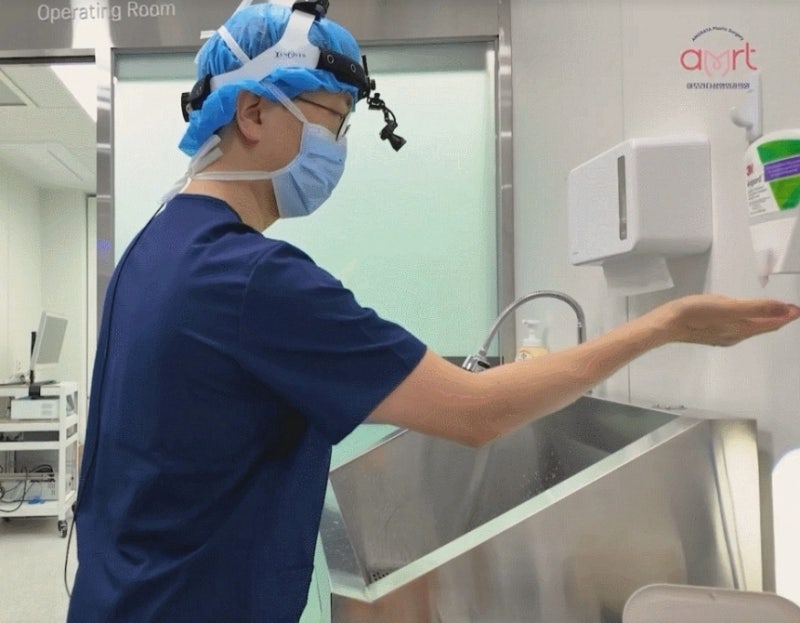
"How should it be prevented?"
Ultimately, the key to preventing capsular contracture
lies in 'thorough infection control.'
It is crucial to verify whether the clinic has an aseptic system
that filters out even airborne dust and bacteria
within the operating theater,
and whether the surgeon possesses the surgical expertise
to minimize the implant's exposure time to air.
Furthermore, you should choose a clinic that provides
systematic aftercare so that the capsule
settles softly and smoothly after surgery.
2. Rippling: Can the Hybrid Approach Help?

Rippling refers to a phenomenon where
the folded, wavy edges of an implant
can be felt under the skin
or become visibly noticeable.
It is particularly common in 'lean-bodied' patients
with narrow rib cages and thin subcutaneous fat layers.
The underlying principle is very simple.
Think of wrapping an object.
If you wrap a hard, angular object
with a single sheet of thin tissue paper,
the shape protrudes through the surface
and looks as if it might tear at any moment.
However, if you wrap it generously
with thick foam or cushioning material,
the original contour does not show through
and appears smooth.
In petite or slender individuals,
the tissue covering the implant is like thin tissue paper,
which makes the implant easily palpable.

"Then must thin patients simply accept rippling?"
Not at all.
If the blanket is too thin,
you can artificially cover it
with a 'thick padded quilt.'
The definitive solution to achieve this
is 'Hybrid Breast Augmentation.'
This technique inserts an implant
to secure definite volume
while simultaneously grafting the patient's own autologous fat
between the implant and the skin
to create a thick, natural buffer zone.
However, this method requires the ability
to precisely evaluate the patient's existing fat layer thickness
down to 1 mm increments
using preoperative ultrasound.
Therefore, make sure to verify whether the medical team
accurately assesses your body structure
and possesses extensive clinical experience
to skillfully execute the hybrid technique.
In conclusion, capsular contracture and rippling
are by no means determined by 'luck.'
If you are hesitating over breast surgery
due to fear of complications,
please carefully examine whether the clinic provides
the 'infection control system' and 'body-customized surgical approach'
discussed today.
When you select a clinic based on rigorous standards,
you will be able to leave behind the fear of side effects
and embrace a safe, beautiful transformation.
<Helpful Columns to Read Together>
Amorata Plastic Surgery |
Main Contact: 02-522-0955 3F, Square Cube, 28 Seocho-daero 78-gil, Seocho-gu, Seoul |
This post was personally written by Amorata Plastic Surgery
in compliance with Article 56 of the Medical Service Act,
with the aim of providing accurate medical information.
All procedures and surgeries carry risks of minor or major side effects
depending on individual conditions,
so please consult thoroughly with a medical specialist before making a decision.
Frequently Asked Questions
Can premium implants prevent capsular contracture 100%?
No, choosing high-end implants alone cannot completely prevent capsular contracture. While modern implant surface engineering has considerably reduced the occurrence rate, the root cause remains microscopic contamination from airborne dust or bacteria during surgery. Hence, surgical safety depends on an aseptic operating theater and strict infection control protocols.
Why does capsular contracture occur?
It occurs when immune cells create an abnormally thick fibrous capsule around the implant in response to subclinical bacterial contamination during surgery. When bacteria settle on the implant surface and generate a biofilm, the immune system erects an exaggerated barrier (the capsule), leading to firmness and aesthetic distortion.
Why is rippling more common in slender body types?
Because the overlying skin and subcutaneous fat tissues are very thin. In individuals with narrow rib cages and minimal breast tissue, the folded edges of the implant can be easily seen or felt under the surface, much like wrapping a rigid object in thin tissue paper.
What is hybrid breast augmentation to prevent rippling?
Hybrid breast augmentation combines implant placement with autologous fat grafting to establish a natural buffer. By transferring harvested fat between the thin skin envelope and the implant based on precise 1-mm ultrasound tissue mapping, it effectively conceals implant edges and prevents palpable wrinkling.